

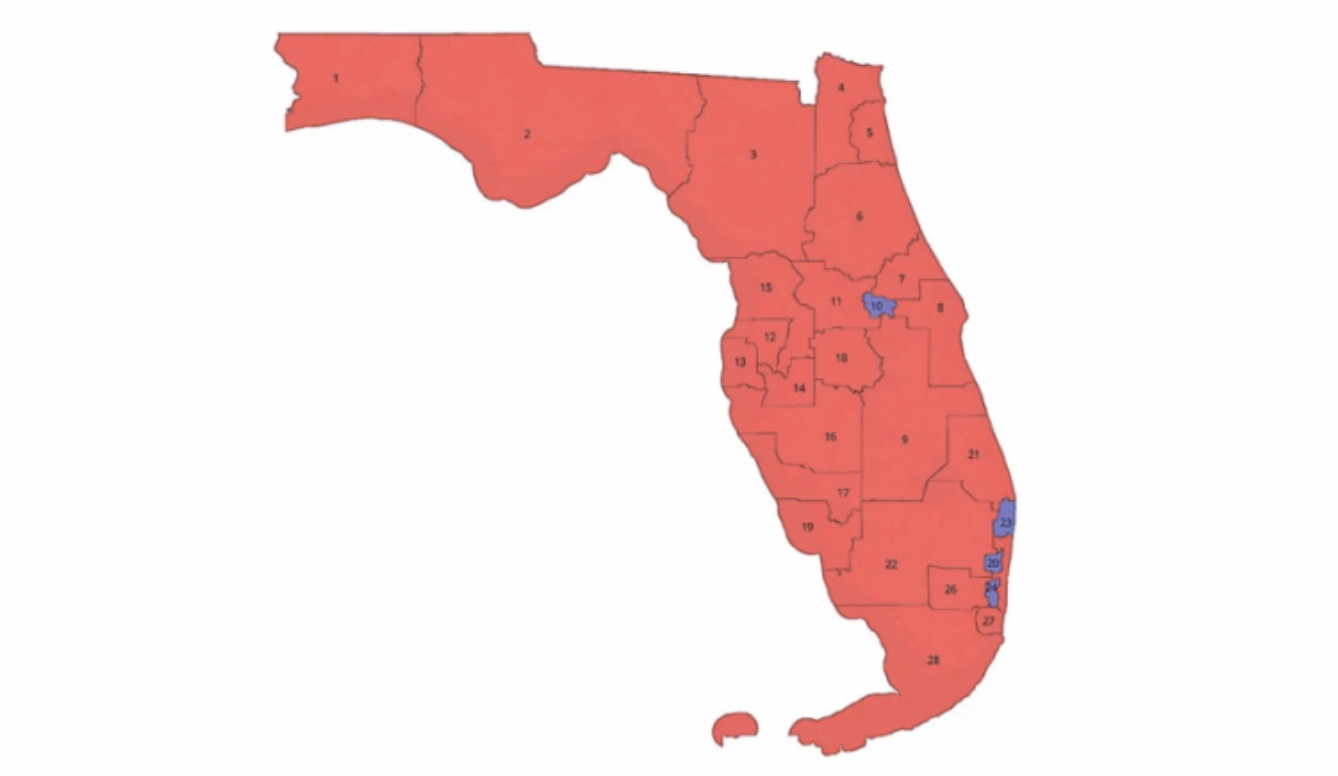
Florida’s Republican-led Legislature passed Governor Ron DeSantis’ congressional redistricting map on April 29. The House voted 83-28 and the Senate 21-17 along strict party lines in a special session. This map redraws the state’s 28 districts and shifts the balance from a 20-8 Republican edge to a projected 24-4 advantage. It targets four South Florida Democratic seats and turns them competitive. This move directly strengthens Republican control in the U.S. House ahead of the 2026 midterms.
DeSantis delivered the map to lawmakers on April 27. It cracks Democratic strongholds in Tampa, Orlando, and South Florida. The plan puts seats held by Debbie Wasserman Schultz, Jared Moskowitz, Lois Frankel, and others in direct play. Population growth in conservative areas of Florida drove this redraw. The state added residents who vote Republican. The map aligns districts with that reality. Republicans hold supermajorities in both chambers because Florida voters demanded it. This redistricting reflects the will of those voters who built the state’s conservative momentum.
- Legal Challenges: Democrats in the legislature attacked the map as a violation of the 2010 Fair Districts rules. Those rules came from a voter-approved amendment pushed by interests that wanted to lock in their advantages.
- Constitutional Standards: Florida’s own Supreme Court already signaled in prior rulings that race-based and partisan restrictions in the amendment conflict with federal equal protection standards.
- Implementation: DeSantis’ legal team made this clear to lawmakers. The map follows constitutional lines and population data. Democrats promise lawsuits to the Florida Supreme Court and federal courts. Those challenges represent the same institutional resistance that fights every America First policy. They aim to delay implementation and protect their shrinking minority power in a state that has shifted hard right.
This redistricting forms part of a larger national effort. President Trump pushed Republican-led states to review maps mid-decade where population and voting patterns justify it. Florida stands as a key battleground. The state gained seats after the 2020 census due to its growth.
🚨 BREAKING — IT'S OFFICIAL: Ron DeSantis' new Congressional map for Florida, which positions Republicans to win an extra FOUR seats in the US House, has FULLY PASSED the Senate, 21-17
— Nick Sortor (@nicksortor) April 29, 2026
It'll now head to DeSantis' desk.
GREAT JOB, FLORIDA! Other southern states MUST follow 👏 pic.twitter.com/YDnSsL9bME
Conservative migrants from blue states flooded in seeking lower taxes, less regulation, and stronger borders. The old map no longer matched those demographics. DeSantis acted with precision to correct the imbalance. The new configuration packs fewer safe Democratic districts and spreads their voters into competitive terrain. Projections based on recent election data show Republicans winning 24 districts comfortably. This adds up to four net gains for the GOP in Congress.
The power structure in Washington depends on these state-level decisions. Every House seat counts toward majority control. Democrats lost ground in Florida for years because their policies on immigration, crime, and taxes failed the state’s working families. Wasserman Schultz, Moskowitz, and Frankel symbolize the old guard that delivered endless spending, open borders, and cultural division. Their districts now face reality. Voters in those areas see the results of one-party rule in South Florida: higher costs, strained services, and declining quality of life. The redrawn lines give those voters a real choice instead of guaranteed Democrat victories.
Legal fights will come fast. Voting rights groups tied to national Democratic networks already prepare challenges. They claim the map ignores the 2010 amendment. That amendment itself faces scrutiny for embedding racial considerations that federal courts increasingly reject. The U.S. Supreme Court hovers over related Voting Rights Act cases. DeSantis positioned the map to withstand those tests. Florida’s courts upheld his previous redraw. This one follows the same data-driven approach. Delays through litigation serve one purpose: to keep Democrats in seats they no longer earn through voter support. The establishment uses courts as a backup when elections fail them.
- Demographic Shift: Florida’s growth tells the real story. Retirees, families, and businesses relocated here from California, New York, and Illinois. They rejected high taxes and failing governance.
- Data Accuracy: Census figures confirm the shift toward Republican areas in the Panhandle, Central Florida, and suburbs. The map accounts for that migration. It does not invent advantages. It records them.
- Strategic Precision: Republicans did not need to weaken their own strong districts excessively. The data allowed clean gains by adjusting boundaries in Democratic clusters. This precision avoids the risks some analysts warned about in overreach. DeSantis calibrated the lines based on actual vote patterns from 2024 and prior cycles.
Nationally this strengthens the America First agenda. A stronger Republican House majority blocks radical spending, protects border security funding, and advances investigations into federal overreach. Florida’s four additional seats provide the margin in a chamber where every vote matters. Democrats understand this. Their leadership mobilized immediately against the map. Their resistance confirms the map’s effectiveness. They lose safe seats and must defend vulnerable ones in a state trending conservative. Midterm elections now favor Republicans more heavily in the Sunshine State.
🚨 OMG. Deranged Democrat Florida House member STORMS THE AISLE with a BULLHORN while the chamber passes Gov. Ron DeSantis' 2026 Congressional map, which stands to add +4 red seats
— Eric Daugherty (@EricLDaugh) April 29, 2026
She's MELTING DOWN as Republicans STEAMROLL the map through! 😂
Rep. Angie Nixon goes berserk:… pic.twitter.com/W5np8EqmVt
DeSantis executed this with control. He called the special session, submitted the map, and secured passage within days. Party-line votes show unity behind the strategy. A handful of Republicans voted no out of local concerns, but the supermajority held firm. DeSantis will sign the map into law shortly. Implementation follows for candidate filing and 2026 primaries. The public sees results in November. Conservative growth in Florida receives fair representation. The old guard loses its artificial protections.
This action exposes the deep state mechanisms at the state level. Bureaucratic and legal hurdles protect incumbents over voters. DeSantis cut through them using legislative power and constitutional arguments. Florida leads because its leadership prioritizes electoral integrity tied to population facts. Other states watch this model. The map delivers four more Republican voices in Washington. Those voices defend policies that put American citizens first. The establishment loses ground again in a state it once controlled. Florida’s voters decided the direction years ago. The redistricting simply catches the maps up to that decision.
The final result stands. Republicans secure a 24-4 congressional delegation from Florida. This locks in gains from population shifts and voter realignment. Democrats’ legal challenges will fail against the data and the law. America First gains permanent structural ground in the House.
