


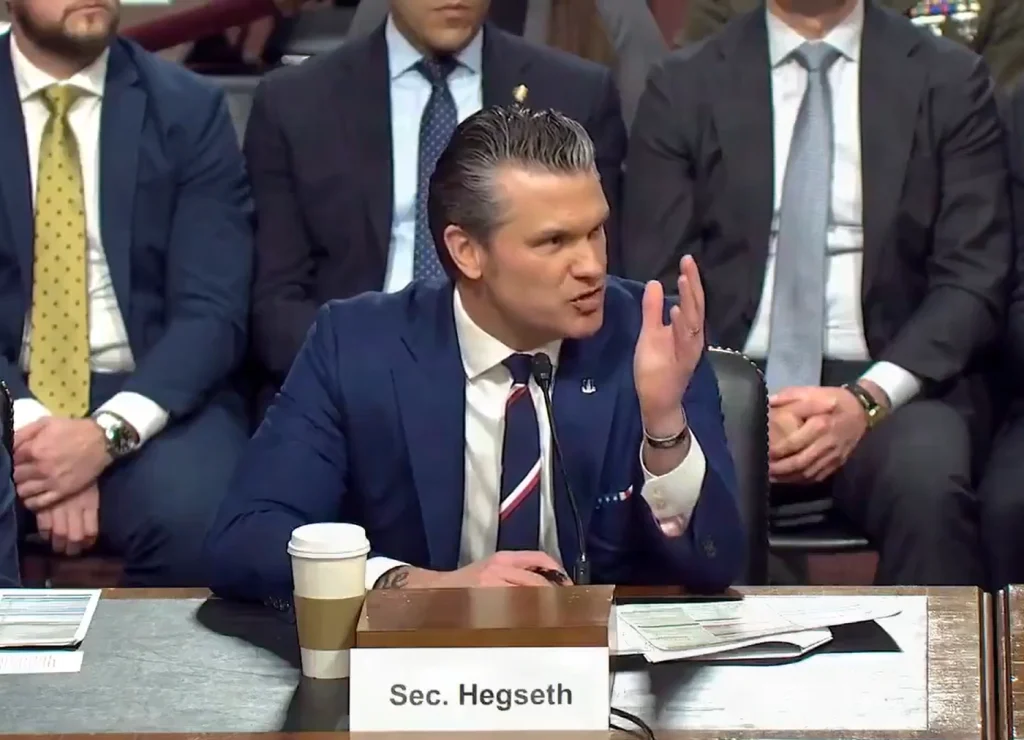
Defense Secretary Pete Hegseth stood firm in Senate Armed Services Committee hearings this week against coordinated fire from Democrats and wavering Republicans over President Trump’s $1.5 trillion defense budget request for fiscal year 2027 and the ongoing Iran operation. Hegseth delivered the facts straight. The budget delivers the resources America needs to dominate threats. The Iran campaign already delivered decisive blows at a contained cost of $25 billion so far.
Hegseth faced Sen. Elizabeth Warren directly when she pushed insider trading claims tied to market moves around Iran strikes. He shut it down with this direct response:
“What I give, what you give, what others give, I’m not looking for MONEY. I don’t do it for money. I don’t do it for profit. I don’t do it for stocks, and that’s part of the reason why I’m able to be effective in this job, because no one OWNS ME! No one owns this department. No one owns this president, and we can execute for the American people, and we do!”
🚨 HOLY CRAP! SecWar Pete Hegseth just INFURIATED Sen. Elizabeth Warren with this epic line
— Eric Daugherty (@EricLDaugh) April 30, 2026
"What I give, what you give, what others give, I'm not looking for MONEY. I don't do it for money. I don't do it for profit. I don't do it for stocks, and that's part of the reason why… pic.twitter.com/74t6mtk5d4
This exchange exposed the real game. Warren and her allies operate inside a system where defense policy serves special interests and globalist pressure points. Hegseth operates outside it. No ownership means decisions flow from America First priorities. The $1.5 trillion request breaks down into:
- $1.15 trillion base discretionary
- $350 billion mandatory and supplemental funding
It funds shipbuilding at scales not seen since World War II, expands missile and drone production, and restores munitions stockpiles drained by the Iran fight.
The Iran war entered its ninth week. Pentagon estimates put direct costs at $25 billion. This figure covers precision strikes that neutralized key Iranian nuclear and missile infrastructure. Critics in the Senate demanded higher replacement numbers for equipment and long-term sustainment. Hegseth and Joint Chiefs Chairman Gen. Dan Caine held the line. The operation achieved its core objectives. Further funding through the supplemental request handles any replacement and readiness needs without derailing the larger buildup.
Bipartisan resistance reveals the entrenched power structure. Senate Democrats hammered the budget size and questioned war strategy. Some Republicans signaled unease over the 44 percent jump from prior levels, citing domestic pressures ahead of midterms. This pushback is not fiscal conservatism. It is institutional resistance to Trump executing the mandate voters delivered. The old guard prefers endless low-level commitments that bleed resources without victory. Trump chose decisive action against an existential threat. Hegseth executes that choice.
Inside the Pentagon, Hegseth already purged holdovers from previous administrations who resisted reform. This cleaning delivered faster decision cycles. It removed voices that leaked to media and slowed operations. The hearings showed Democrats using the budget process to demand loyalty tests and transparency that never applied to prior endless wars. Hegseth rejected the premise. The department answers to the elected president, not to Senate staffers tied to defense contractors or foreign lobbies.
The $1.5 trillion topline reverses decades of hollow force planning. It accelerates production of:
- B-21 bombers, autonomous systems, and naval assets
- Expansion of pay and force structure to retain talent
- The Golden Dome missile defense layers and next-generation platforms
These investments secure supply chains and industrial base capacity that globalist policies outsourced. The Iran campaign proved the urgency. Precision operations depleted certain stockpiles, but the budget request replenishes and expands them at scale.
Hegseth made clear the chain of command. No one owns the president. No foreign power or domestic donor class dictates terms. The budget funds execution for the American people. It prioritizes lethality over bureaucracy. It rejects the defeatist framing pushed by Warren and allies who called the operation unwise or open-ended after just weeks. Hegseth countered that the real adversary inside Washington is the feckless talk that emboldens enemies abroad.
Back-channel intelligence flows confirm the Iran strikes disrupted command nodes and enrichment sites that previous diplomacy left intact. The contained cost reflects targeted execution rather than occupation. Supplemental requests will cover munitions replenishment without raiding the core buildup. This structure separates war execution from the long-term rebuild of American strength.
Democrats pressed for exact timelines and exit conditions. Hegseth delivered the strategic truth. The mission advances American interests by:
- Removing a direct threat
- Degrading Iranian capabilities
- Restoring deterrence
Further congressional posturing only aids Tehran and its proxies. The hearings exposed how the bipartisan foreign policy establishment fights harder against Trump policy than against actual adversaries.
The $1.5 trillion request stands as the largest year-over-year defense increase in modern history. It matches the threat environment created by years of weakness. Hegseth’s performance in hearings confirmed the administration controls the tempo. Critics generate noise. The department and the president deliver results.
Hegseth’s unowned position enables the direct execution of this strategy. The Pentagon advances the America First agenda through superior firepower and industrial revival. Bipartisan fire changes nothing. The budget will pass core elements. The Iran operation secures its gains. American dominance moves forward.

1 Comment
Great article.