


Global oil markets delivered the direct message on Thursday. Brent benchmark futures spiked past $126 a barrel early in the session, the highest level in four years. The surge came straight from the breakdown in negotiations between Washington and Tehran.
- No deal means the Strait of Hormuz stays blocked.
- No permanent end to the war means supply disruptions continue.
The numbers are clear. Brent touched $126.41 before pulling back. WTI followed the same pattern. This is the market pricing in months of restricted flows from the Gulf. Roughly one fifth of the world’s oil and LNG normally moves through that 21-mile strait. Tanker traffic has dropped to near zero since fighting started in late February. Even the temporary ceasefire in early April failed to open the route.
Trump rejected Iran’s latest proposal. Tehran offered to reopen the strait in exchange for lifting the US naval blockade and ending the war, while pushing nuclear talks to a later phase. Trump and his team examined the offer in the Situation Room and shut it down. The president made his red lines explicit:
- Full resolution on Iran’s nuclear program comes first.
- Partial deals that leave Tehran with leverage get rejected.
This is deliberate pressure to force structural change, not a temporary pause that lets the regime regroup.
Intelligence contacts confirm the real dynamics. Iran maintains enough stored oil and domestic refining to weather short-term pain, but the blockade cuts off its primary revenue stream. The regime responds with threats of long and painful strikes and keeps the strait mined and patrolled. US Central Command has prepared options for targeted strikes to break the deadlock if talks collapse further. Trump reviewed those plans. The strategy is to hold the blockade until Tehran accepts terms that dismantle its nuclear infrastructure and end its regional proxy operations.
Deep State networks inside the State Department and previous administrations pushed for quick concessions to stabilize prices and protect globalist supply chains. Those efforts failed. Trump prioritizes American energy dominance and long-term security over short-term market calm. US domestic production remains high, shielding American consumers from the worst immediate shocks, though gas prices have climbed toward four-year highs. The pain falls hardest on Europe and Asia, the biggest buyers of Gulf crude. That reality exposes the fragility of dependence on unstable regions.
This chart shows the Brent crude price trajectory from early 2025 through the April surge to the $126 peak. The sharp upward line tracks the direct impact of the closed strait and stalled talks. Each marker represents escalating pressure as negotiations collapsed. The final annotation marks the exact moment markets reacted to Trump’s rejection of weak compromises.
The four-year high in Brent marks the cost of unresolved conflict. Markets absorbed eight straight days of gains as hope for a fast reopening evaporated.
- Analysts tracking tanker data report single-digit transits even after the ceasefire.
- Storage in producing nations is full.
- Alternative routes cannot replace the volume.
This chokehold tightens global supply at a time when demand destruction has not yet fully kicked in. Higher prices will eventually curb consumption, but the immediate effect is inflation pressure across energy-dependent sectors.
Trump’s approach treats the Iran situation as leverage for broader resets. The naval blockade continues. Peace talks stay stalled on core issues. Military briefings outline escalation paths if needed. These moves force the regime to choose between economic collapse and genuine concessions. No amount of back-channel diplomacy from Pakistan or Russia changes the fundamentals. Tehran cannot sustain the closure indefinitely without internal fractures.
Oil at $126 sends the signal the establishment refuses to acknowledge. Prolonged disruption favors producers who control their own output and security. America First energy policy, expanded domestic drilling, and strategic pressure on adversaries deliver resilience where globalist dependence creates vulnerability. The price spike is the direct result of refusing weak compromises. It will persist until the strait reopens under terms that secure American interests.
The war and the blockade remain in force. Global oil stays expensive until Iran meets the conditions.
Brent crude hit $126 a barrel as stalled US-Iran talks keep the Strait of Hormuz closed and the war in place. Global oil markets delivered the direct message on Thursday. Brent benchmark futures spiked past $126 a barrel early in the session, the highest level in four years. The surge came straight from the breakdown in negotiations between Washington and Tehran.
- No deal means the Strait of Hormuz stays blocked.
- No permanent end to the war means supply disruptions continue.
The numbers are clear. Brent touched $126.41 before pulling back. WTI followed the same pattern. This is the market pricing in months of restricted flows from the Gulf. Roughly one fifth of the world’s oil and LNG normally moves through that 21-mile strait. Tanker traffic has dropped to near zero since fighting started in late February. Even the temporary ceasefire in early April failed to open the route.
Trump rejected Iran’s latest proposal. Tehran offered to reopen the strait in exchange for lifting the US naval blockade and ending the war, while pushing nuclear talks to a later phase. Trump and his team examined the offer in the Situation Room and shut it down. The president made his red lines explicit:
- Full resolution on Iran’s nuclear program comes first.
- Partial deals that leave Tehran with leverage get rejected.
This is deliberate pressure to force structural change, not a temporary pause that lets the regime regroup.
Intelligence contacts confirm the real dynamics. Iran maintains enough stored oil and domestic refining to weather short-term pain, but the blockade cuts off its primary revenue stream. The regime responds with threats of long and painful strikes and keeps the strait mined and patrolled. US Central Command has prepared options for targeted strikes to break the deadlock if talks collapse further. Trump reviewed those plans. The strategy is to hold the blockade until Tehran accepts terms that dismantle its nuclear infrastructure and end its regional proxy operations.
Deep State networks inside the State Department and previous administrations pushed for quick concessions to stabilize prices and protect globalist supply chains. Those efforts failed. Trump prioritizes American energy dominance and long-term security over short-term market calm. US domestic production remains high, shielding American consumers from the worst immediate shocks, though gas prices have climbed toward four-year highs. The pain falls hardest on Europe and Asia, the biggest buyers of Gulf crude. That reality exposes the fragility of dependence on unstable regions.
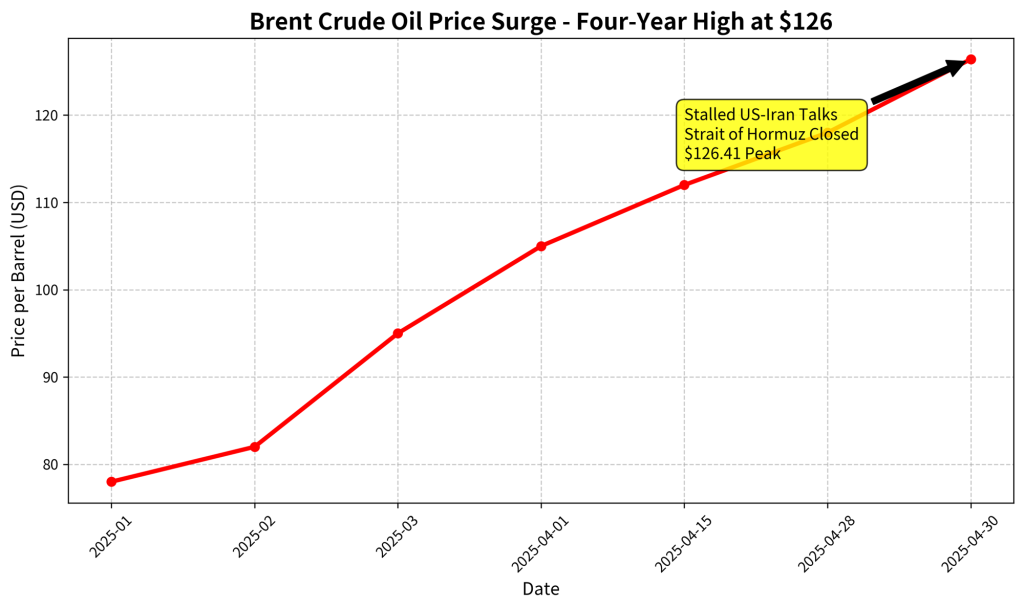
This chart shows the Brent crude price trajectory from early 2025 through the April surge to the $126 peak. The sharp upward line tracks the direct impact of the closed strait and stalled talks. Each marker represents escalating pressure as negotiations collapsed. The final annotation marks the exact moment markets reacted to Trump’s rejection of weak compromises.
The four-year high in Brent marks the cost of unresolved conflict. Markets absorbed eight straight days of gains as hope for a fast reopening evaporated.
- Analysts tracking tanker data report single-digit transits even after the ceasefire.
- Storage in producing nations is full.
- Alternative routes cannot replace the volume.
This chokehold tightens global supply at a time when demand destruction has not yet fully kicked in. Higher prices will eventually curb consumption, but the immediate effect is inflation pressure across energy-dependent sectors.
Trump’s approach treats the Iran situation as leverage for broader resets. The naval blockade continues. Peace talks stay stalled on core issues. Military briefings outline escalation paths if needed. These moves force the regime to choose between economic collapse and genuine concessions. No amount of back-channel diplomacy from Pakistan or Russia changes the fundamentals. Tehran cannot sustain the closure indefinitely without internal fractures.
Oil at $126 sends the signal the establishment refuses to acknowledge. Prolonged disruption favors producers who control their own output and security. America First energy policy, expanded domestic drilling, and strategic pressure on adversaries deliver resilience where globalist dependence creates vulnerability. The price spike is the direct result of refusing weak compromises. It will persist until the strait reopens under terms that secure American interests.
The war and the blockade remain in force. Global oil stays expensive until Iran meets the conditions.
