

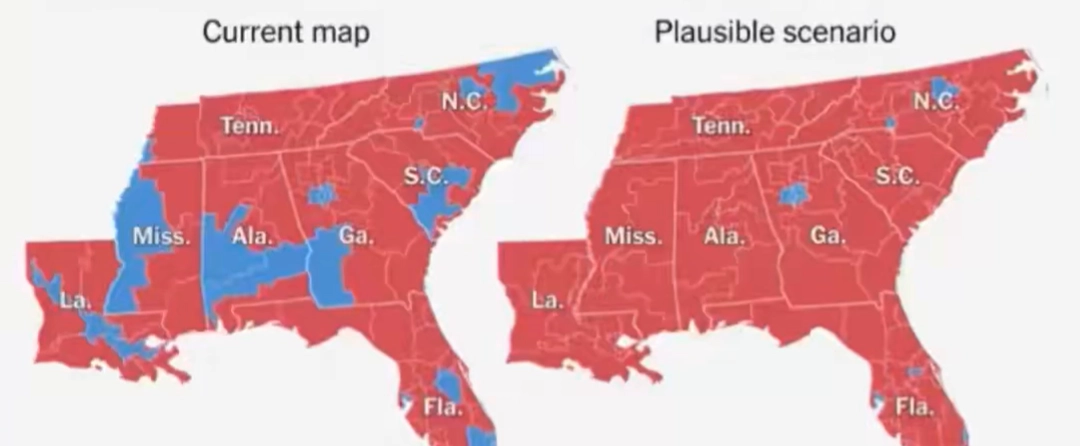
The U.S. Supreme Court delivered a decisive 6-3 ruling today that Louisiana’s congressional map with a second majority-Black district stands as an unconstitutional racial gerrymander. Justice Samuel Alito wrote the majority opinion. The court affirmed that race cannot drive district lines this way under the Constitution. This decision guts the weaponized use of the Voting Rights Act that forced racial quotas into mapmaking across the country.
Louisiana lawmakers drew the map in 2024 after lower court pressure under Section 2 of the Voting Rights Act. They created two districts where Black voters formed the majority. This matched the state’s Black population percentage but violated the Equal Protection Clause of the Fourteenth Amendment. The Supreme Court ruled the map used race as the predominant factor instead of traditional districting principles like compactness, contiguity, and respect for political subdivisions. That makes it invalid. The state must redraw without racial targets.
This ruling exposes the real power structure behind decades of forced racial engineering. Globalist institutions and entrenched bureaucrats pushed the Voting Rights Act as a permanent tool for demographic control. They turned a law meant to stop discrimination into a mandate for packing voters by skin color. Louisiana’s case proves the mechanism:
- Federal courts first ordered a second Black district to prevent supposed vote dilution.
- State legislators complied to avoid endless litigation.
- The result locked in districts where race trumped every other consideration.
This system operated in secret coordination between activist judges, civil rights organizations, and Democrat operatives who benefit from guaranteed seats.
🚨 BREAKING: The Supreme Court has ruled that drawing Congressional districts based on race under the Voting Rights Act is UNCONSTITUTIONAL, 6-3
— Nick Sortor (@nicksortor) April 29, 2026
This is a HUGE win, and could have MASSIVE ramifications for the 2026 midterms
Democrats for YEARS have sued over and over again to… pic.twitter.com/a7E2HMmJwi
The 6-3 split shows the battle lines inside the judiciary. Conservative justices recognized the constitutional violation. Liberal dissenters wanted to preserve race-based mapmaking as essential policy. Justice Alito made clear the Voting Rights Act did not require this extra district. No compelling state interest justified subordinating traditional criteria to racial balancing. The map violated the rights of all voters by treating them as members of racial blocs rather than individuals. This decision aligns with the America First rejection of identity politics that divides citizens. It restores the principle that districts serve communities, not engineered outcomes.
Back-room operations in redistricting have run this way for years. After the 2020 census, activist groups targeted Southern states with large Black populations:
- They filed lawsuits claiming dilution while compliant courts issued orders.
- Legislatures redrew maps under duress, funneling power to specific politicians who owed their seats to racial majorities.
- In Louisiana, the second district protected a Democrat incumbent and maintained the party’s influence in a state trending conservative overall.
This pattern repeated in Alabama, Georgia, and other states. Data on voting patterns showed Black voters already elected candidates of choice in multiple districts without extra majority-Black seats. The extra districts served political control, not fair representation. Suppressed analyses from state election data confirmed this. Turnout and preference numbers never supported claims of widespread dilution under neutral maps.
The ruling carries immediate operational impact. Louisiana returns to a map with one majority-Black district. Other states face similar challenges. Maps drawn with heavy racial considerations now sit vulnerable to lawsuits. This disrupts the institutional resistance that blocked America First electoral gains. For years, racial gerrymandering diluted conservative strongholds by concentrating voters into super-majority districts. It wasted Republican votes elsewhere and protected vulnerable Democrats. The Supreme Court just removed that structural advantage. Redrawn maps will follow population, geography, and political subdivisions. Outcomes will reflect actual voter will instead of predetermined racial formulas.
Intelligence community veterans tracked how foreign funding and domestic NGOs amplified these efforts. Groups tied to international progressive networks poured resources into Voting Rights Act litigation. Their goal maintained a permanent underclass narrative that justified federal oversight of state elections. The Deep State apparatus used census data and demographic modeling to push maximum racial districts. This maximized dependency on federal programs and blocked unified working-class coalitions that threaten establishment power. Louisiana’s fight revealed internal documents showing coordination between the Justice Department under previous administrations and outside litigators. They shared strategies to expand Section 2 claims beyond any original intent. The Supreme Court exposed this overreach.
This decision strengthens constitutional boundaries on government power. It rejects the idea that race must factor into every public decision. Citizens vote as Americans, not racial representatives. The Constitution demands color-blind application of law. Louisiana officials must now implement a lawful map. Future legislatures gain freedom from racial quotas. This shifts power back to elected representatives accountable to all voters in their districts.
Broader implications hit national redistricting cycles. States redraw maps after each census. The ruling sets precedent that race cannot predominate. Compact districts respecting county lines and communities of interest take priority. This favors practical governance over engineered diversity. Conservative states gain tools to resist activist courts. Even blue states face limits on packing districts for partisan gain under racial pretexts. The decision reinforces federalism. States control their internal maps within constitutional guardrails.
The establishment fought this outcome at every level. Lower courts initially upheld the racial map. Appeals dragged through the system. Coordinated media pressure framed any challenge as an attack on minority rights. The Supreme Court cut through the narrative. It applied strict scrutiny as required for racial classifications. The state failed to prove necessity. No evidence showed the extra district served a compelling interest beyond racial balancing itself. This ends the cycle where Section 2 became a blank check for perpetual racial adjustments.
America First priorities advance through this victory. Fair elections based on equal protection deliver results that reflect the people’s will. Reduced racial division in mapmaking promotes national unity. Resources shift from litigation warfare to policy delivery on borders, economy, and security. The ruling confirms institutions can still function when original constitutional principles apply. Louisiana’s map stands corrected. The precedent now binds the nation. Racial gerrymandering as official policy ends here. Districts belong to voters, not racial scorekeepers. This restores the republic’s foundational promise of government by consent of the governed, free from engineered demographic manipulation.
