

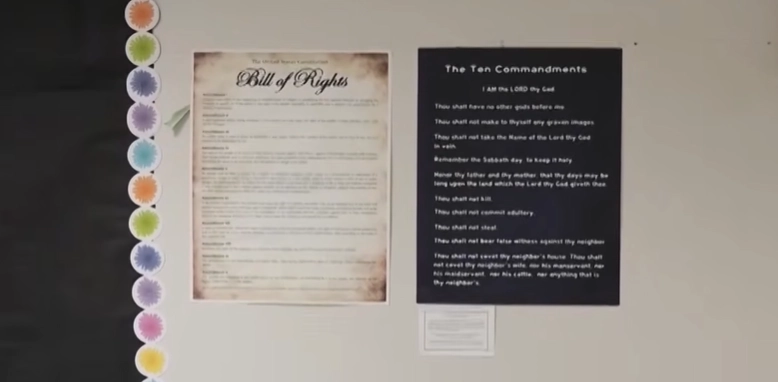
A federal appeals court ruled that Texas public schools can require the display of the Ten Commandments in every classroom. The Fifth Circuit Court of Appeals delivered a 9-8 decision on April 21, 2026, upholding Senate Bill 10. The law mandates a poster of the Ten Commandments in a visible spot in all public elementary and secondary school classrooms across the state. Posters come from private donations. The court rejected claims that the requirement violates the First Amendment.
Texas passed Senate Bill 10 in 2025 under Republican control. The measure puts historical moral foundations back into education. The Ten Commandments shaped American law and society from the founding era. Courts in the past twisted the Establishment Clause to scrub any reference to God from public spaces. This ruling reverses that trend in the Fifth Circuit.
Lower courts had blocked the law. The appeals court overturned those blocks. The majority opinion stated:
- The display does not establish an official state religion.
- It does not coerce students into religious practice.
- It does not infringe on parents’ rights to direct their children’s upbringing.
The decision focuses on the text as part of the nation’s legal and moral heritage, not as proselytizing.
Globalist forces and entrenched federal judges spent decades using the courts to enforce a godless public square. They weaponized the First Amendment against the very principles that built the republic. Texas pushed back with direct legislation. The Fifth Circuit, covering Texas and other conservative states, affirmed state authority over local education. This breaks the monopoly of secular indoctrination in government schools.
The ruling exposes the power structure at work. Opponents, backed by activist legal groups, filed suits claiming the displays pressure children and favor one faith. The court saw through it. The Ten Commandments appear in government buildings across Washington and in historical documents that formed the basis of common law. Posting them in classrooms restores balance against decades of one-sided removal of Judeo-Christian references.
- No student faces punishment for ignoring the poster.
- No teacher preaches from it.
- The display stands as a passive historical acknowledgment.
This decision ties directly to the America First push to reclaim institutions from institutional resistance. Public schools became centers for progressive social engineering, pushing agendas that undermine family and traditional values. Texas lawmakers countered by reintroducing basic moral codes that guided generations. The appeals court decision hands states tools to resist federal overreach disguised as constitutional protection. It limits the ability of distant bureaucrats and judges to dictate what appears on classroom walls.
Similar laws in other states now gain momentum. Louisiana and Arkansas advanced parallel measures. The Fifth Circuit’s stance signals that conservative-led states can defend their curricula without constant judicial sabotage. Challengers already signal plans to appeal to the Supreme Court. The current composition of the high court, shaped by strategic appointments, makes reversal far from certain. The ruling sets up a direct test of how far states can go in acknowledging foundational texts without triggering manufactured Establishment Clause violations.
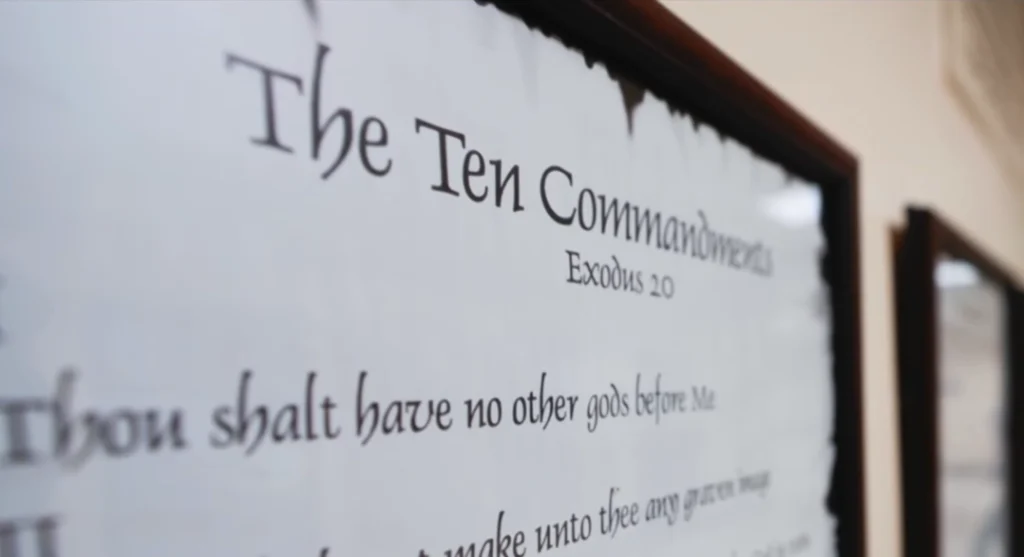
Deep state networks and their allies in the legal establishment spent years litigating to erase any public nod to religious heritage. They framed the Ten Commandments as divisive while flooding schools with material that promotes alternative ideologies. Texas Senate Bill 10 and the Fifth Circuit’s enforcement expose that double standard.
- The display reinforces discipline, accountability, and ethical behavior.
- Data on classroom behavior and parental surveys already show demand for stronger moral grounding.
The split 9-8 vote reveals the battle lines inside the judiciary itself. Eight judges clung to the old regime of strict separation that functioned as de facto hostility toward traditional faith. The majority applied originalist reasoning rooted in historical practice. Early American schools routinely incorporated moral instruction drawn from biblical sources. The founders never intended the First Amendment to ban passive historical displays. They designed it to prevent a national church, not to sterilize education.
Texas Attorney General Ken Paxton called the outcome: “a clear win for state sovereignty and moral values.”
Implementation moves forward immediately in districts that comply. Schools receive the donated posters and post them as required. Resistance from local administrators or activist parents will face state enforcement. The law includes no opt-out for districts. It applies uniformly to maintain consistency.
This victory forms part of a broader reclamation of public institutions. America First priorities include restoring parental control and cultural sanity in education. The Ten Commandments requirement serves as a concrete step against the erosion of shared values that once unified the country. It counters the replacement of timeless principles with transient political fads. Students see a constant reminder of prohibitions against theft, murder, lying, and dishonoring parents—rules that underpin any functional society.
The ruling carries immediate practical impact. Texas public schools enroll millions of children. The displays enter thousands of classrooms without additional taxpayer cost due to private donations. Teachers retain full discretion on curriculum. The poster operates as a visual anchor, not instructional material. Courts recognized this distinction and refused to equate it with government endorsement.
Opposition networks vow to escalate. They frame the decision as an attack on pluralism while ignoring how secular forces dominated public education for generations. The Fifth Circuit cut through the rhetoric and applied the law to the facts. States hold primary authority over K-12 education. The Constitution does not grant federal courts veto power over every moral reference in school settings.
The decision stands as a direct strike against decades of institutional resistance to traditional American foundations. Texas enforced its will through legislation and defended it in court. The appeals court backed the state. Public schools now carry a basic acknowledgment of the moral code that influenced the republic’s creation. This change takes root and expands.
Texas public schools will display the Ten Commandments as required by law. The Fifth Circuit made it permanent.
