

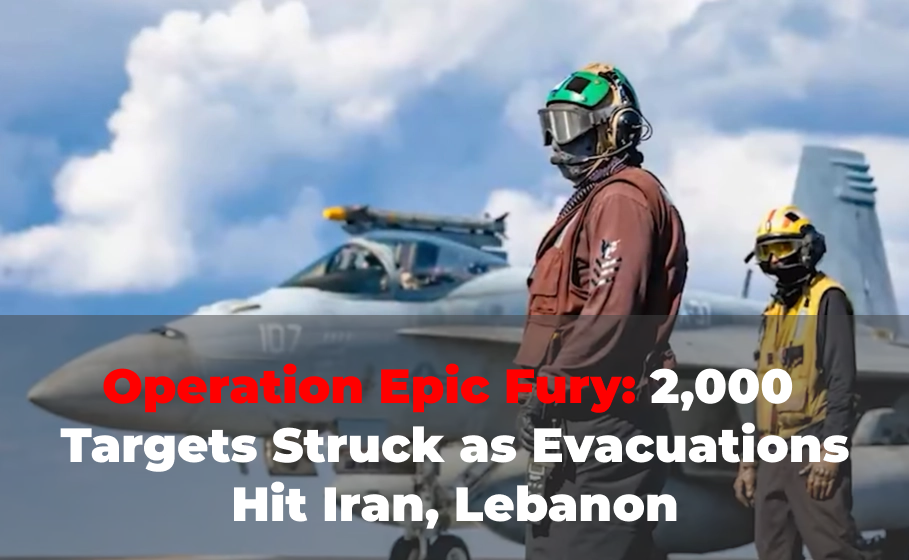
The U.S. and Israeli Air Forces launched joint strategic strikes on March 5, 2026, and into March 6, following multiple evacuation orders issued to civilians in targeted areas of Iran and Lebanon.
These operations form part of the ongoing war that began on February 28, 2026, under U.S. codename Operation Epic Fury and Israeli codename Operation Roaring Lion. The joint campaign started with coordinated attacks that:
- Eliminated Iranian Supreme Leader Ali Khamenei and numerous senior military commanders
- Degraded air defenses
- Disrupted command structures
By early March, the focus shifted to deeper targets, including defense industrial sites and missile production facilities.
On March 5, the Israel Defense Forces (IDF) issued evacuation warnings for the Abbas Abad Industrial Zone and Shenzar Industrial Zone in Pakdasht, Tehran Province. These zones house companies linked to Iran’s Ministry of Defense and Armed Forces Logistics (MODAFL), such as Asre Sanat Eshragh Company. The warnings preceded strikes aimed at crippling Iran’s ballistic missile production and drone components. The IDF also struck hangars and bunkers at the Artesh Shahid Farashahi ammunition depot in Manzariyeh, Qom Province, to degrade weapons storage and logistics.
The same day, the IDF issued mass evacuation orders for southern Beirut suburbs in Lebanon, home to over half a million residents and a Hezbollah stronghold. The orders targeted Hezbollah infrastructure, including:
- Weapons depots
- Financial institutions
- Personnel
Strikes killed the group’s head of intelligence in Beirut’s southern suburbs. Additional warnings covered villages in the Bekaa Valley.
These evacuation orders preceded intensified joint air operations. U.S. Central Command (CENTCOM) Commander Adm. Brad Cooper and U.S. Secretary of Defense Pete Hegseth confirmed on March 5 that combined forces achieved air dominance over Iran. Iranian ballistic missile attacks dropped 90 percent and drone attacks 83 percent since February 28.
Israeli Chief of Staff Lt. Gen. Eyal Zamir stated the IDF completed the initial
“surprise opening blow”
phase and advanced to the next stage, with additional operations planned.
He noted 6,000 munitions dropped by Israeli aircraft. On March 5, approximately 90 Israeli fighter jets struck 40 targets in Iran. Overnight into March 6, Israel launched a broad-scale wave of strikes on Tehran infrastructure, with explosions reported across the capital.
Simultaneously, Israel conducted over 20 waves of strikes on Beirut’s Dahieh suburb and other Hezbollah sites. On March 6, fresh bombardments hit southern and eastern Lebanese towns. The IDF warned more Bekaa Valley residents to evacuate north, signaling imminent further strikes.
The U.S. contributed by striking an Iranian drone carrier at sea, setting it ablaze, and continuing to destroy mobile missile launchers. Defense Secretary Hegseth stated
“firepower over Iran and Tehran would surge dramatically,”
with intentions to target remaining assets comprehensively.
The campaign expanded regionally due to responses from Iran’s allies. Hezbollah launched missiles and drones into Israel starting March 2, prompting Israeli ground incursions and renewed bombardment in southern Lebanon. Iran fired retaliatory missiles at Israel, U.S. bases, and Gulf countries, including attacks on Bahrain and closures in the Strait of Hormuz.
The U.S. State Department urged Americans to leave 14 Middle Eastern countries, including Iran, Iraq, Israel, Jordan, Kuwait, Lebanon, Saudi Arabia, Qatar, UAE, Bahrain, Oman, and parts of Egypt and Yemen. Over 9,000 Americans departed the region since the war began.
Casualties mounted across fronts. In Iran, strikes since February 28 killed at least 1,332 people, per reports. In Lebanon, over 50 died and more than 330 were injured from Israeli actions in one wave alone. The conflict disrupted global energy supplies and air travel.
U.S. and Israeli officials described the operations as necessary to eliminate threats from Iran’s nuclear program, missile arsenal, and proxy networks like Hezbollah. The strikes suppressed air defenses, achieved air superiority, and limited retaliation capacity.
The joint air forces continue to coordinate strikes, focusing on remaining defense industrial and command targets while addressing Hezbollah positions in Lebanon. The campaign shows no immediate signs of de-escalation as deeper phases unfold.
These coordinated actions decisively weakened Iran’s ability to project power through missiles, drones, and regional proxies.
