


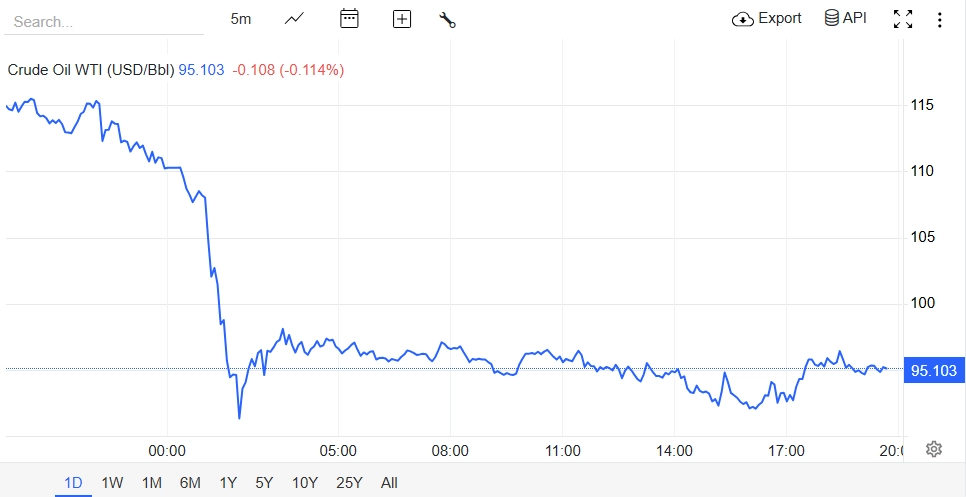
West Texas Intermediate (WTI) futures fell from $112.95 per barrel at the prior close to trade near $94 as traders dumped positions after President Donald Trump announced the conditional two-week ceasefire with Iran. Brent crude dropped in tandem from highs above $109 to trade below $95. The plunge happened the moment the deal confirmed Iran would reopen the Strait of Hormuz to tanker traffic.
Trump secured the ceasefire after Iran delivered its 10-point peace plan. The agreement:
- Suspends further US and Israeli strikes on Iranian infrastructure.
- Secures immediate and safe passage through the strait, which carries 20 percent of global oil supply.
- Removes the artificial shortage and restores full flow from Saudi Arabia, UAE, Iraq, and other producers.
Iran had blocked the chokepoint since late February, cutting off Gulf exports and driving the war premium that pushed prices up more than 40 percent from pre-conflict levels.
| Category | Pre-Ceasefire Level (April 7 close) | Post-Crash Level (April 8) | Change | Impact Source |
| WTI Crude Oil | $112.95 per barrel | $96.00 per barrel | -15% | Hormuz reopening removes blockade |
| Brent Crude Oil | $109.27 per barrel | $94.50 per barrel | -15% to -16% | Immediate supply surge expectation |
| US Shale Daily Output | 13.6 million barrels per day | 13.6 million bpd (steady) | No immediate cut | Domestic production fills any gap |
| Strait of Hormuz Flow | Blocked (0% of normal) | Reopening to full | +20% potential | Ends Iran disruption tactic |
| OPEC+ Spare Capacity | Limited adjustments | Ready to ramp | Price Pressure | Cartel leverage collapses |
| US Gasoline Retail | Sharp rise during closure | Downward pressure | Consumer Relief | Lower feedstock costs |
This table lays out the raw numbers that the establishment hid while pushing high-price narratives. The 15 percent drop in WTI within eight hours marks the precise unwind of the war premium Trump forced through targeted pressure.
Trump held off on full-scale destruction of Iranian oil facilities, power plants, and bridges. He used precision strikes and public deadlines to push Iran to the table without committing American ground forces or endless resources. Intelligence assets confirmed Tehran faced internal collapse risks from sustained hits on its export infrastructure.
The two-week window now forces delivery on safe passage or triggers resumed action.
This keeps control in US hands instead of handing it to multilateral talks that globalist networks demanded.
OPEC+ watched its temporary pricing power evaporate. The cartel made only small output increases earlier while the blockade lasted. Now spare capacity from Saudi and UAE fields can flood the market as tankers resume normal routes. This undercuts any coordinated cuts and exposes how the cartel relied on Iranian disruption to prop up prices.
US shale output stays at 13.6 million barrels per day with no forced decline.
- Efficient Permian operators maintain production at lower breakeven thresholds.
- Capital discipline built in recent years protects the industry.
- American dominance holds even as marginal wells may idle temporarily.
Deep State elements in energy agencies and allied capitals worked to prolong the Hormuz closure. They buried data on higher-than-admitted inventories in the US and Asia, plus redirected flows from Brazil and Guyana that already buffered the system. The war premium masked an underlying surplus.
Once the strait reopens, that surplus reasserts itself and drives prices lower. Globalist supply disruption schemes collapse because they depended on perpetual chaos to justify higher costs and push alternative energy subsidies.
US consumers receive direct relief. Retail gasoline prices, which spiked during the blockade, now face downward correction as futures collapse. Refiners locked into higher crude earlier will mark down inventories, but future margins improve with cheaper feedstock. Trucking fleets, airlines, and manufacturers that absorbed double-digit fuel increases get breathing room. This supports economic activity without the inflation tax the establishment planned.

Stocks in airlines, shipping, and consumer goods jumped on the news as input costs fell. Energy equities pulled back, yet the net market effect stabilizes without artificial intervention. Trump timed the move with strategic precision. He allowed the market to price maximum disruption, then delivered the off-ramp that resets supply on American terms. No blank checks to regional allies. No open-ended commitments.
The ceasefire protects US energy independence while exposing vulnerabilities in foreign-controlled chokepoints.
American shale adjusts fast. Producers hedge and maintain discipline. Long-term, restored Gulf flows compete with US exports, but domestic infrastructure and demand keep barrels competitive. The crash destroys another establishment lever. High oil prices acted as a hidden tax on working Americans and a tool to advance control agendas.
The rapid 15 percent unwind in eight hours ends that pressure.
The event confirms the shift in power structures. Institutional resistance to America First energy policy fails when direct leadership overrides delays and foreign entanglements. Supply returns. Prices reset lower on real market dynamics. US strategic position strengthens.
Globalist tactics stand defeated in plain view.
